Building referral pathways that reflect real relationships: RIVIAM’s new referral functionality for supporting people, their carers and family members
17 March 2026
For Integrated Neighbourhood Teams (INTs), Local Authorities and NHS healthcare providers, referrals need to reflect the reality of people’s lives. Joined-up care depends on recognising the connections around a person, not just the individual themselves. It often involves carers, relatives, children and wider family relationships, with different care services needing the right information at the right time.
That is why we have developed new functionality for RIVIAM’s Referral Management and Multi-agency Referral Hub services.
The challenge with treating connected people as separate referral journeys
Until recently, RIVIAM’s referral form completion process could create multiple referrals for one person in one instance and route these digitally to care services, but it was still built around a single individual. That works well in many scenarios, but it creates friction where support needs to extend across more than one person.
For one customer, Bath and North East Somerset (BaNES) Community Wellbeing Hub (CWH), one of the clearest examples of this issue is when a professional is referring both a person and their carer, and referrals need to be completed for both in one referral. Previously, that meant the referral would arrive with information and requests about the person and not the contacts around them.
For care providers, the issue is bigger than process inefficiency. If referral infrastructure cannot reflect real relationships between people, it becomes harder to deliver joined-up, neighbourhood-based care in practice.
Our new functionality explained
With RIVIAM’s new development, one referral form can now create referrals for multiple people and multiple services simultaneously.
This functionality also does more behind the scenes to make the referral usable and actionable by providers.
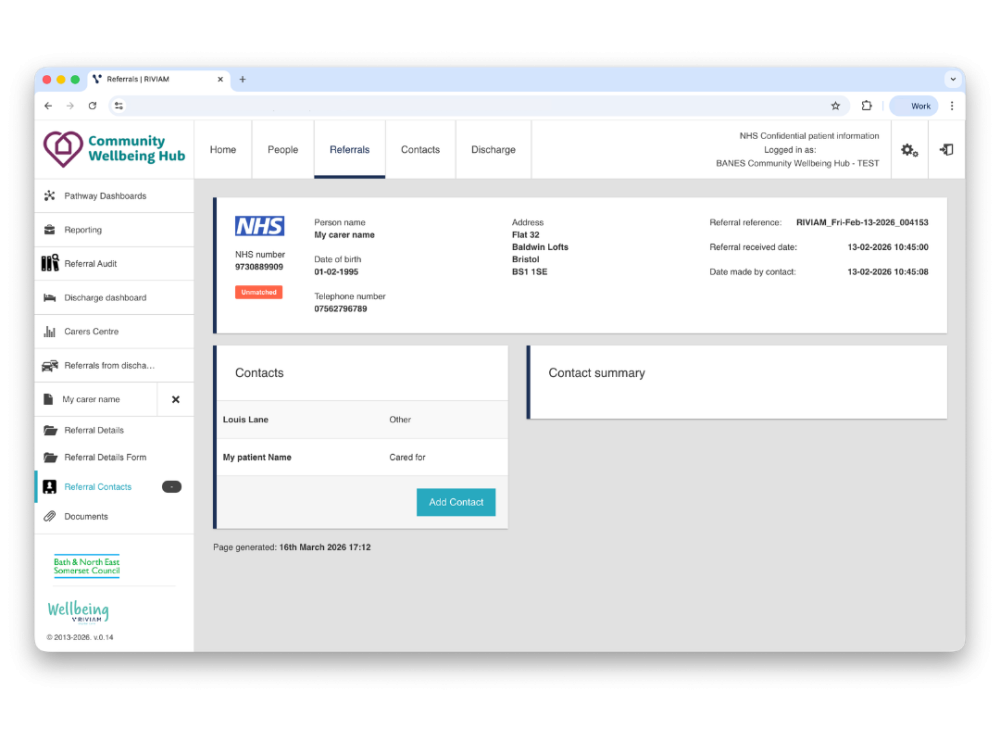
It creates and updates separate records for the person and their contacts on RIVIAM.
And it generates a referral PDF for the person and a separate referral PDF for the contact’s referral, with the relevant information for each service.
RIVIAM can also enable a Personal Demographics System (PDS) check on both the person and the contact, helping identify the NHS number and therefore enabling access to the local Shared Care Record where appropriate (and where this service has been enabled by RIVIAM).
Related contacts in RIVIAM present the relationship between the two (or more) care records, so RIVIAM users can see the link between the people involved.
How the BaNES Community Wellbeing Hub will use the functionality
The CWH is a partnership of 38 health, social care and VCSE organisations across BaNES. It plays an important role in delivering joined-up care, early intervention and making sure people can access help without being passed from service to service.
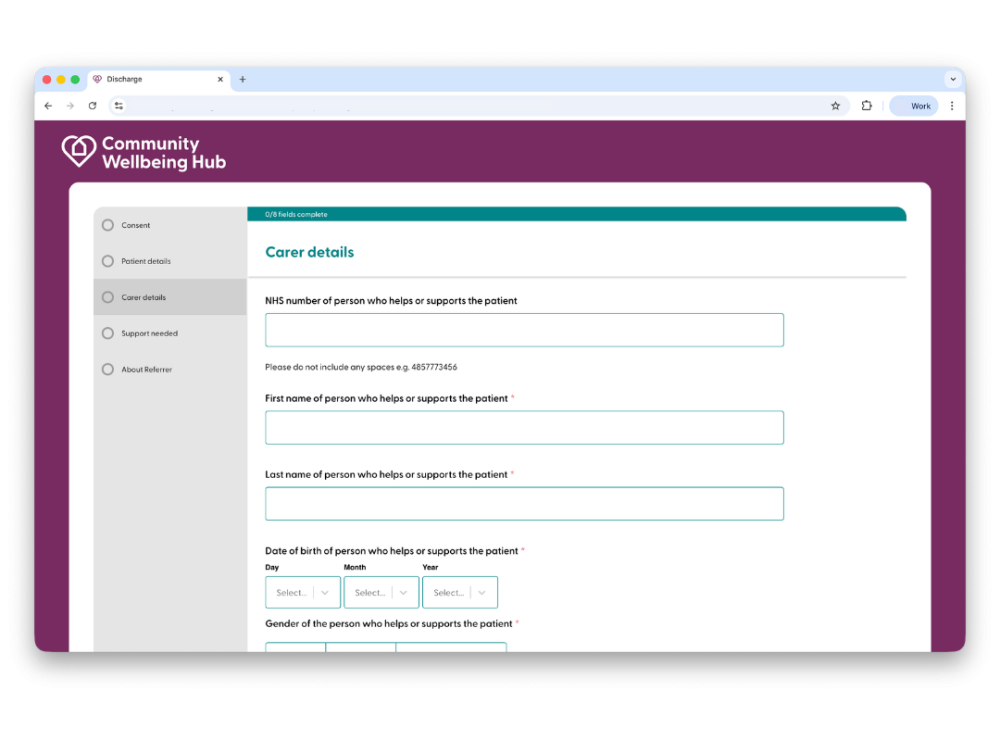
This new functionality is now used in the referral forms for the CWH - a professional can complete a referral for a person and request support for their carer within the same form. You can see the Hospital to Home referral form here.
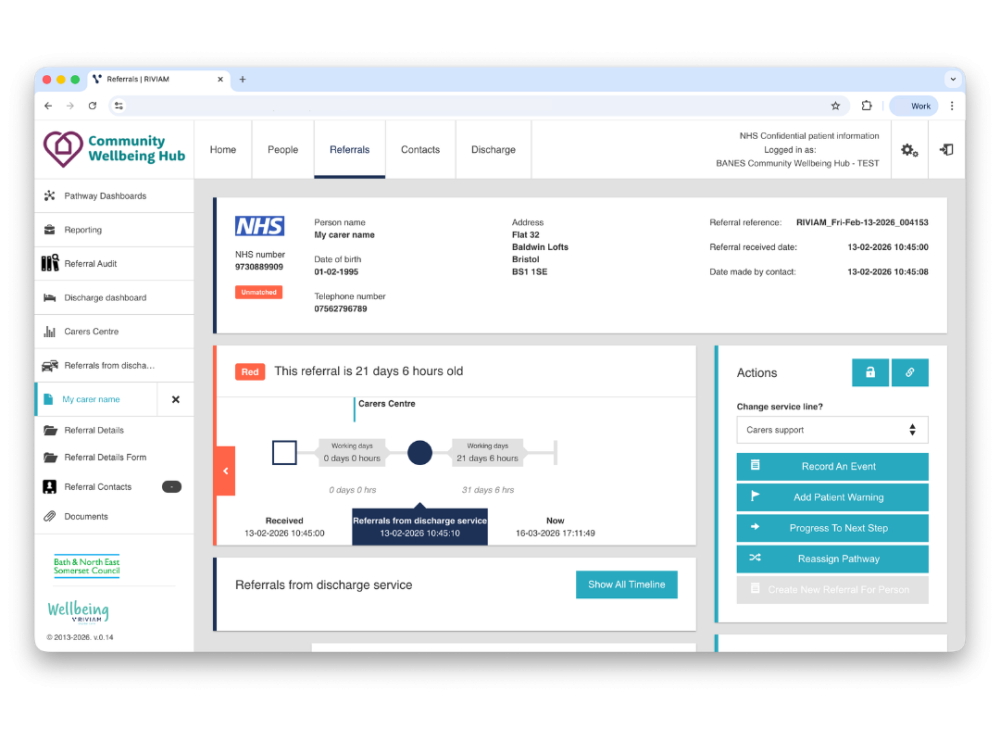
When the carer details are included during the form completion process, the system automatically creates the appropriate onward referral for the Carers’ Centre*, sending the necessary and relevant information into their workflow on RIVIAM.
That means the carer’s details are not simply captured as background context. They become a distinct referral pathway for the service that will support them.
Why this matters for the Carers’ Centre
Carers need to be visible in the system as people in their own right, not just as supporting detail attached to somebody else’s referral. By automatically creating a referral based on the carer’s information and sending the details to the Carers’ Centre, the process becomes more accurate, more efficient and more useful to the receiving service.
It also supports better access to information. Because the PDS check can be carried out for both patient and carer, the Carers’ Centre can securely access the BaNES Integrated Care Record for the carer. This enables a more inclusive view of the person they are working with.
It's the difference between a referral form that captures information and a referral platform that helps services act on it properly.
Previously the Carers’ Centre had to review the patient referral, identify the relevant carer details and manually create the referral to support the carer. This added time, created duplicate administration and slowed down access to support.
“RIVIAM has not taken a one-size-fits-all approach. They have listened to our feedback and developed functionality that reflects the specific needs of carers and our service. That means a more practical referral process for our team, better use of staff time and capacity, and a system that works more effectively for the people we support. This new functionality is a big stepping stone towards future developments for young carers, families and other connected referral pathways.”
~ Sophie Kiernan, Carers Support Services Manager at The Carers' Centre
Why this matters for the Community Wellbeing Hub
The CWH exists to make support easier to access and easier to co-ordinate across organisations. Its role as a single point of access (SPoA) depends not only on partnership working but on digital processes that support that way of working. The hub’s model is designed to reduce duplication, improve triage and strengthen collaboration across community services.
This RIVIAM development enables exactly that, it:
- Reduces the need for teams to re-enter information manually
- Makes referrals more relevant to the receiving care service
- Strengthens visibility between connected records.
And by linking multiple people and referrals more effectively, it gives professionals a clearer understanding of the wider context around an individual’s care.
For Multi-Disciplinary Teams, Local Authorities, health and social care partners, that matters. Better referrals do not just save time. They improve handovers, strengthen shared understanding and help services respond to people’s circumstances and needs more holistically.
What it means for commissioners and providers
For commissioners and providers, this is a practical BaNES example of how referral technology can support Integrated Neighbourhood Teams and integrated health and social care.
It also addresses a clear local priority.
Carers’ support is important to the BaNES healthcare system, and the ability to route relevant information directly to the Carers’ Centre improves how that support is delivered.
“RIVIAM and the Community Wellbeing Hub (CWH) partners worked closely to co‑design improvements that support a collaborative, person‑centred approach. We are pleased with the new feature, which highlights carers at the very start of an individual’s referral journey. This helps ensure that support for the whole family can be put in place as early as possible. The ethos within the CWH is that partners actively shape the solutions, and thanks to RIVIAM’s openness and willingness to engage, this improved functionality has been successfully created.”
~ Callum Graham Robertson, Programme and Project Manager (Transformation), Strategic Commissioning Hub at Bath and North East Somerset (B&NES) Council
This also demonstrates something broader.
Referral forms do not need to be limited to one person at a time. With the right logic, workflows and data structure behind them, they can support real-world relationships and connected needs.
That is important for any system looking to strengthen prevention, streamline multi-agency working and make better use of shared records and digital infrastructure. It is also important for commissioners thinking about future service models.
As neighbourhood teams mature, referral pathways need to support households, carers and families, not just individual episodes of care.
Referrals for families
RIVIAM’s referral forms can now include support for parents and children, or other connected individuals whose support needs sit across more than one service.
The future of referral management is not simply about digitising a paper process. It is about designing pathways that match the way care is organised around people, relationships and communities.
Interested in learning how we can support your Integrated Neighbourhood Teams or Local Authority Safeguarding teams deliver more integrated care for an individual, their contacts and family?
Contact us on [email protected]
*The Carers’ Centre is a CWH partner that supports unpaid carers across BaNES with information, advice and services to help them stay well in their caring role.