
Why RIVIAM's Service Directory is built on Open Referral UK
10 November 2026
RIVIAM's accessible, easy-to-use Service Directory helps residents and professionals discover local health, wellbeing, social care and community services, supporting earlier intervention and greater independence.
But we didn't want to build another 'closed' directory.
We wanted to help Local Authorities and other provider organisations make better use of their local service information, which is why we've adopted Open Referral UK standards.
Why is Open Referral UK important
A voluntary organisation runs a weekly support group.
The time changes.
That change now needs making on the organisation's own website, in the council directory, in an NHS resource and in two or three referral and social prescribing systems. Some get updated, some do not, and within a few months there are several versions of the same service and no way to tell which is right.
As health and care put more emphasis on prevention, early intervention and helping people find support in their communities, accurate information about local services matters more than it ever has.
For social prescribing teams, NHS organisations, councils and voluntary and community organisations, knowing what support exists, who it is for and how people can reach it is the difference between someone finding the right service and being passed between organisations.
The example above is the longstanding problem. Service information keeps becoming another silo.
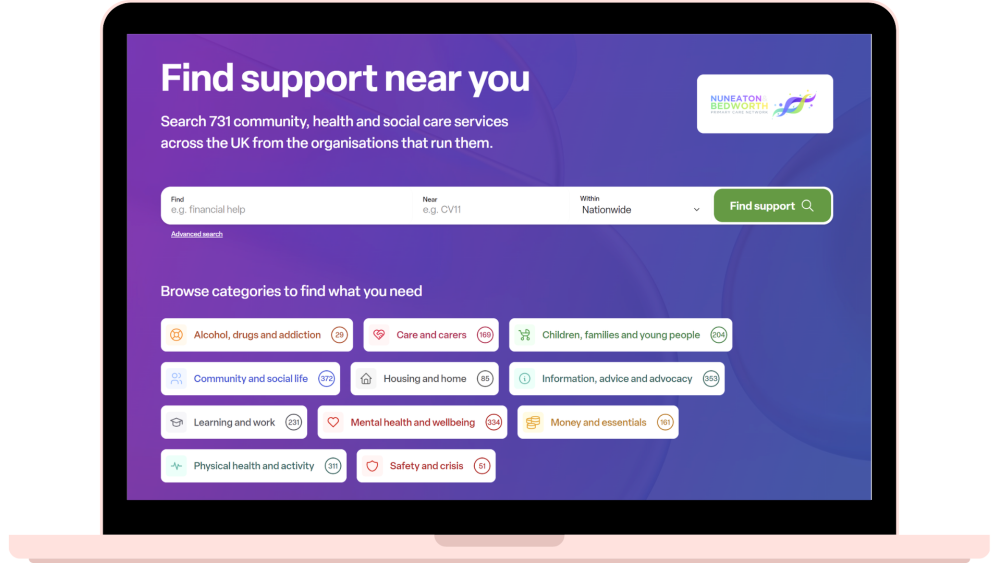
Managing a local service directory?
Discover how RIVIAM can help you share dependable service information using Open Referral UK.
Maintain once, reuse everywhere
At RIVIAM, we did not want to add to this problem.
Our Service Directory is built around a simple principle: an organisation and a venue should exist once, as a single record, and every participating directory should draw on that record.
Two neighbouring social prescribing services listing the same charity see the same organisation, the same address and the same contact details, rather than two copies drifting apart. Each RIVIAM customer then chooses which services appear in their own directory.
The principle is to maintain dependable service information once and make it easy to reuse wherever it is needed.
Our direction of travel is a federated model, where organisations that run services ultimately maintain their own records and make them available to every directory that wants to list them.
Built on Open Referral UK
For that to work, information has to be structured consistently.
That is why the Service Directory supports Open Referral UK (ORUK), the open standard for describing and sharing information about community services. ORUK is the UK adoption of the international Open Referral standard, and it has been approved by the Data Standards Authority for use across government.
A common standard means organisations, services, locations, eligibility and contact details are described the same way everywhere, and are made available through a standard API. Rather than people copying service information between systems, the systems exchange it directly.
Two features of the standard matter in practice.
First, ORUK describes services only. It carries no personal data, which keeps it clear of the obligations that make sharing anything patient-related expensive and slow.
Second, ORUK recommends a shared set of taxonomies for tagging services by type, need and circumstance, published by the Local Government Association. Consistent tagging is what lets several directories be searched as if they were one.
RIVIAM’s commitment to open standards and interoperability
Supporting ORUK is part of a wider RIVIAM commitment to open standards and interoperability. Health organisations, Local Authorities and the voluntary, community and social enterprise sector should be able to share information about services easily, rather than each holding a different version of the same facts.

Open to read, controlled to publish
An Open Referral UK feed is open data.
Anyone can read the published information about a service, and that is the point: the information is only useful if it can travel.
What is controlled is who gets to put information there.
RIVIAM's Service Directory is designed so that the organisations and services it lists are known and vetted. Nobody can create an account and publish a service themselves. Services are curated through RIVIAM customers, with clear oversight of which organisations are represented, where each record came from and when it was last reviewed. Only reviewed, published records reach the feed; drafts and withdrawn listings never leave the directory.
This matters because health, social care and social prescribing teams rely on this information to help people find appropriate support. Open standards give the information reach; curation gives it dependability.
As the Service Directory develops, RIVIAM plans to give the organisations the ability to manage their own information directly, while keeping clear ownership and appropriate controls in place.
A dependable foundation for AI
RIVIAM is exploring how our Sadie AI services could sit on top of the Service Directory to help professionals find appropriate services more easily.
The quality of any AI-powered search depends on the information it draws from. Rather than asking an AI to search the open web for an answer, our intention is for Sadie AI to work from the defined, curated service information in the directory, and nothing else. Because the directory holds information about services rather than about people, there is no patient data in that foundation.
That gives professionals a clear boundary around what the AI is drawing on and a far more dependable basis for identifying relevant support.
An open approach to better connected care
Service directories were once a relatively simple piece of digital infrastructure. As health and care place greater emphasis on prevention, neighbourhood working and connecting people with community support, they are becoming essential.
Better directories should not mean more isolated systems. By building on Open Referral UK, RIVIAM wants to make it easier for health, social care and voluntary sector organisations to share accurate information about services, while cutting the duplication that lets it go stale.
It is one example of a principle we hold firmly: open standards, combined with careful curation, connect organisations and services so that people can find the right support more easily.
Interested in learning more?
If you run a directory, publish service information or are thinking about how your organisation could use ORUK, we would like to hear from you.